Update from Qudus' blog

May 9, 2013

Revue de STILL/life


« Still/Life » de Qudus Onikeku. 

La Maison de la Danse invite à Lyon, dans le cadre du festival La Maison Sens Dessus Dessous, le stupéfiant danseur nigérian Qudus Onikeku.
Still/life, les 25 et 26 mai au Nouveau Théâtre du Huitième, 22 rue commandant Pégout-Lyon 8.

Danse - Qudus Onikeku - © Sarah Hickson
(© Sarah Hickson)

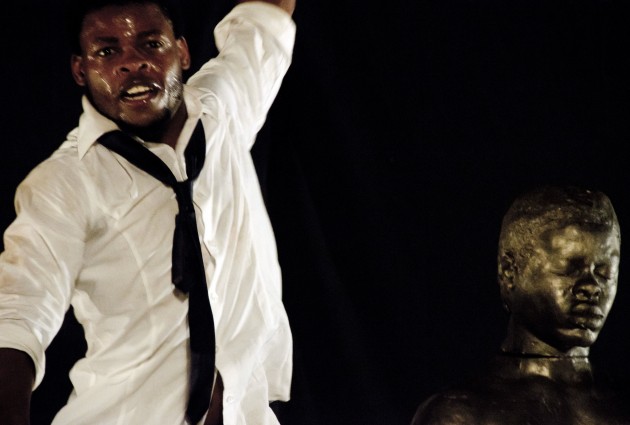
Still life signifie “nature morte”. Ce n’est pourtant pas une corbeille de fruits que peint Qudus Onikeku dans son spectacle. Séparant les deux mots d’un slash (Still/life) c’est sur la brèche qu’ouvre leur combinaison, “encore ici, en vie” que le danseur tisse de multiples variations. Les tragédies de l’histoire africaine traversent sa pièce comme autant de touches chromatiques, de fragments composant un ensemble abstrait. Pas de récit, encore moins de commentaires : Qudus Onikeku est le maître d’une cérémonie brute et virtuose qui pose cependant une question : «qu’est-ce qui fait qu’un homme peut se transformer subitement en monstre ?». La transformation d’une victime en bourreau, le tiraillement et les conflits intérieurs sont les motifs du rituel, traités comme des inspirations chorégraphiques plutôt que comme des thèmes documentaires. Formé à l’acrobatie, aux danses traditionnelles de son pays (le Nigéria) ainsi qu’à la danse contemporaine, Onikeku s’affranchit des styles et atteint un état de présence magique, subjuguant d’intensité. Sa danse est tout à tour féline et tellurique, il dévore l’espace avant de se replier, mutique ou provocateur, sur lui-même. Pour trouver ces états de corps uniques, il voyage beaucoup. Il emprunte à la philosophie yoruba, dont il se revendique l’héritier, ses préoccupations : la pluralité des mémoires, la non-linéarité du temps, le présent comme lieu ultime de la relation. Et la confronte, au fil de ses recherches et créations, aux cultures du monde entier. Un monde entier qu’il ramène, dans Still/life, sur quelques mètres carrés. L’espace y est borné par une conque de panneaux comme autant d’écrans sur lesquels la lumière peut se réfléchir et des images mentales se projeter ; une toile en morceaux, une mémoire éclatée en bris de verre entre ordre et chaos. Qudus Onikeku évolue dans ce décor sur la musique live de Charles Amblard et le chant, entre cris, ode et implorations, de Habeeb Awoko. À ce stade de complicité entre les trois hommes, on ne peut plus guère parler de solo ; chacun répond au souffle et à l’énergie de ses compagnons, dans un échange à la fois extrêmement réglé et ouvert à chaque instant à l’improvisation. Still/life, pièce créée dans une première version avec le danseur chorégraphe Damien Jallet, est une bonne occasion pour découvrir cet artiste unique et prometteur avant son prochain spectacle, Qaddish, présenté au Festival d’Avignon.

Feb 27, 2013

Defending my own Name. 'Qaddish'

Defending my own Name. 'Qaddish'

In the face of the world, I'm undoubtedly a Black and an African man, but the question for me has never been in the realm of denying nor romanticizing, not worrying whether I'm black enough or being too African. We live under a construct which have placed more emphasis on defining and outlining who we are, so rather than just dancing and communicating ourselves in our own simple and naive manners, we now - through the obligation of the other - spend time imitating an idea of ourselves. For me, there will be no denying nor romanticizing, for this is usually the price to pay in acquiring that legitimacy that is offered to traveling artists outside their terrain, but rather I look at things more holistically and all inclusive. So it's always about how to communicate my own ideas of the world, how to defend my name without dissociating myself from and above misrepresentation? I don't require any validation for that. 

For clarity of motive, I begin by stating that my real given name is Adul-Quddus, an Arabic root name which translates to 'the servant of The Holy' but if simply called Quddus, it means Holy. in Aramaic language, Quddus transforms to Qaddish.

In 2009/2010 all my personal preoccupations were concerned mostly with question of exile and solitude, deconstructing the concept of home as static four walls, but gravely in search of aloneness and alienation, and seeking ways of gaining access to the deepest part of my inner self, a process that was so required when the rupturing divorce with Nigeria blatantly stares me strongly in the face, then I created 'My Exile is in my Head'. In 2011/2012, the quest moves further to trying to undo the myriad lies and errors in human history, denying the very existence of history and nation-states, but to argue that the sole motive that makes up a society, are different individuals, making selfish decisions to support their personal interests, and so I created STILL/life, wondering what it is that prop up the minds of men, that they set up ideas which they later think they can bow down and offer sacrifices to, and in the process transforms them into murderous monsters. 

Now again, the quest has led into newer byways. From recreation of the self, to the negation of history, and now to the quest for memory. As my dance practice intensifies, the perception becomes even clearer, my body protest that there are things to remember, things that I never knew that I know, body memory that is. When I dance I remember, when I stop dancing, my conscious memory becomes too short and perhaps too corrupted to go that far and clear. So my preoccupation lately have been to return - in a manner of speaking - to somewhere deep in the earth, to link the far past with the present, the living with the dead, the human with the divine and the present with the near future. I have began work on a new piece, QADDISH which is the last part of this existential trilogy of mine, in which I've initiated a journey with my 80 years old father, a journey we are starting from his hometown Abeokuta. 


Journeys in general term serves as trope for the Yoruba, in cognitive aesthetic terms. Its aesthetics development, even in everyday speech, serves as a primed prefix to any wise saying, rendered as Yorùbá bọ, that is, the "Yoruba retorts or returns", "Retorts" in this sense shares a verb and semantic equivalence with "returns". In other words, Knowledge and discovery are predicated on a temporal and spatio-spiritual journey. Qaddish will exhibit several dimensions of this spiritual journey in space and time. Time present, past and future dialogue will compete for attention. An aspect of this will be evident in the display of an interactive Wheelchair, whose presence in space will trigger a dialog with the past, and its auto movement in space compels us to acknowledge the present. 

Drawing from the Yoruba cosmogony and collaborating with modern day use of robotic technology, the Wheelchair will embody the metaphor of the space-time continuum as in most African masks. Breaking the words literally, we get 'wheel', usually used to pierce time and space, and 'chair' as a static designed object slowing down time and marking a static space, since time cannot be separated from space, we have 'time-space,' in other words, the undecoded 'wheel-chair' is fossilized message, a single instance that is representative of other instances, other spaces and times, it is a repository of the intrinsic connectedness of temporal and spacial relationship, of a time past and of current knowledge such as myth, legend and the history such paradox exhibits. 

Through its evocation of several dimensions of time, realized in the congealed narratives of the figurative sculpture of condensed myths, current discourses, and a power to prognosticate, the wheelchair suggests a multimedia event, even in its static state, it compel a visual discourse. The chair will exercise an anarchic force upon perceptions, breaking down compartmentalizing categories by being able to move unaided by living beings and uninhibited between reality and magic, the referential and the semantic. 


In my approach to art, one thing is clear, this one thing however, might be seen as connection of many things that have simultaneously come to rest within my restless mind, and my body have created a precept and a refuge for these complexities. My personal need for comprehension, for finding answers to the many questions that surfaces on my mind on a daily basis, together with my own personal artistic preoccupation, with a dire need to heel and to advance art and humanity, and to be a bridge between aesthetics that has either been wrongly understood or dismissed as low art, and in all of that i have also find a space for my spirituality, in search of unity with the cosmos, with God and hoping to recover a certain verticality, to recover the authentic self that is neither subjugated to norms, history, the past nor thrown aback in his right to the assured presence. This meant for me tapping into age long Yoruba philosophies, which already neatly outlined the part of the self, of alterity, of the commune and of the divine, in its imagination and the role of aesthetic beauty and of art. With enough skills, talent, experience and knowledge, that i have been able to gather and exercise through my practice, i hope to take from this diverse sources aesthetic and transpose them into contemporary, and urban context. 

I am particularly animated by body memory, rather than history, by the will to reach out and communicate with the audience, above the will to express something of the self, and in so, I've constantly searched for ways to fuse poetic attitudes with a particularly traditional satirical and fictitious modes of story telling, as in the griot tradition, combining both social history, collective memory or collective amnesia with personal autobiography, as a critical lunching pad in the process of myth reading and communal rejuvenation. In most of my works - including group pieces - the dancer is always given the dramaturgic and choreographic liberty, to present himself as himself but pointing to something else, there is restricted level of show off, but a responsibility of an interpreter and the humility of a messenger. Through self exposure and auto derision, or self fortification and self proclamation, the dancer also weans his audience from any license of criticism they might have of both his art and the message thereon.

I have by no means felt at ease with the saying that "Dance is a language" or a 'form' of 'expression' and often outraged by audiences who want - by all means - to understand my performance, as one probably understands a piece of writing. Language can do less when dance is in view, and 'forms' denote something fixed. Body movement, or simply put, action has always been a superior mode of thought and of communication, therefore, the contextual meanings in my performances are neither eternal nor immutable, but mere signifiers in time and space. For me, a performance is simply an experience, not a cerebral one however, it is rather a brief shared moment of vitality, of healing, of social purification, where i sometimes make allusions to antisocial behaviors, but above all it is to mediate between the here and then and to make balance. 

My audience are invited to share communicative experience through many different sensory channels simultaneously; verbal, musical, choreographic and visual aesthetic dimensions, they all become part of the components of the total message, whereby there exist a personal alchemy between the 'performers' and every member of the audience, because in the Yoruba tradition, we believe that the eyes has got only two foods that feeds it, one is Iran, a magical spectacle or a choreographic display and the other is ewa, which is beauty. As beauty is relative, magical spectacle and choreographic display takes more of my attention, because it creates its own beauty in its own terms. 

This shows the importance the Yoruba attaches to intense and visceral body movements, artistic, acrobatic, or magical display, as a means of securing attention and thereby influencing both the human and the divine. Spectacle (Iran) in this sense denotes an happening that seldom occurs in everyday life, and hence a relish for the eyes. Conversely, Iran spanning from the root word iranti (remembering) is a memorable experience, lingering visually and aurally in the subconscious. In the visual art, an image or sculpture is called Aworan, a contraction of A-wo-ranti (a visual reminder) literally "what we look at to remember." Beyond and above the need to delight the senses alone by entertaining or educating it, a performance is also to establish a direct (active) body to (passive) body transmission, as well as a framework for regulating the social and cosmic orders. 


Jan 31, 2013

Tours and Calendar

Calendar 2012/2013.


3 - 12 January     - WIP La Villette (Creative residency STILL/life)
13 January          - WIP La Villette (Public Presentation STILL/life Work in Progress)
16 - 20 January   - CND Pantin (Creative residency STILL/life)
24 - 27 January   - Theatre de l'Agora. Evry (Creative residency STILL/life)
30/01 - 04/02      - CND Pantin (Creative residency STILL/life)
06 - 11 February - CND Pantin (Creative residency STILL/life)
14 - 16 February - L'Arc Scène Nationale Le Creusot. (Show My Exile is in my Head + Screening Do We need ColaCola to Dance?)


19 February       - The Performing Art Market - Yokohama (Show - STIll/life work-in-progress version)
20 February        - Institut Française Tokyo (Show - STILL/life work-in-progress version)
18/02 - 04/03      - Theatre Bretigny Val d'Orge (Creative residency STILL/life)
12 - 16 March     - Centre Culturel de Porte de l'Essonne Athis Mons (Creative residency STILL/life)
17 March            - Théâtre Arlequin de Morsang sur Orge (Show My Exile is in my Head)
19 - 21 March     - Festival International CDC Toulouse (Show My Exile is in my Head)
19 - 23 March     - Centre Culturel de Porte de l'Essonne Athis Mons (Creative residency STILL/life)
24 March            - Centre Culturel de Porte de l'Essonne Athis Mons (Premiere STILL/life)
25 March            - Theatre Bretigny Val d'Orge (Show 2 STILL/life)
30 March            - Théâtre des Ulis (Show 3 STILL/life)
31 March            - Théâtre de la vallée de l'Yerres. Brunoy (Show 4 STILL/life)


27 April - Speaking at the TEDxIfe conference in Ife, Osun state. Nigeria.
5 May - Festival La Voix est libre @Theatre Garrone. (Improvisation with Dieudonné Niangouna)
10 May - Festival La Voix est libre @Bouffes du Nord. (Improvisation with Dieudonné Niangouna)
17 - 29 May - ADC Geneva  (research residency)
29 May - 1 June - Modul Dance Festival. LUJBIJANA SLOVANIA (Show STILL/life)
18 June - Prize giving for PRIX SACD in Paris - Awarded the NEW CHOREOGRAPHIC TALENT
22 June - 1 July - Festival Platform Kinshasa (Show STILL/life)
1 July - 7 July - Lagos/Abeokuta (Research QADDISH - Creation 2013)
7 - 11 August - Dancing in Levée des conflits by Boris Charmatz Hamburg. Germany.
14 August - 24 August - Festival Correios em Movimento Rio De Janeiro (Show My Exile is in my Head)
My Exile is in my Head - MC theatre Amsterdam. 25 - 26 September
My Exile is in my HeadParktheater Eindhoven. Netherlands. 27 September
My Exile is in my HeadBijlmer Parktheater Amsterdam Zuidoost. 28 September
Modul-Dance conference - Tilburg Netherlands. 1 - 3 October
My Exile is in my Head - Albany Deptford. London. 4 October 
My Exile is in my Head - Dukes Theatre Lancaster. 6 October 
My Exile is in my HeadLakeside Arts Centre Nottingham. 11 October
My Exile is in my HeadDrum Theatre Birmingham. 13 October
My Exile is in my Head - Contact Theatre Manchester. 16 October
My Exile is in my HeadThe Courtyard Theatre, Hereford. 18 October 
My Exile is in my Head - Sherman Theatre, Cardiff. 20 October


QADDISH (Research residency) - CND - Pantin. France 2 - 12 November 
Africa initiative Group conference - Yamoussoukro Ivory Coast. 15 - 18 November
QADDISH (Research residency) - Rimbun Dahan. Kuala Lumpur 20 November - 15 December
QADDISH (work -in-progress) - Dancebox. Kuala Lumpur 22 November
QADDISH (work -in-progress) - IB Theatre Conference - TaPS. Kuala Lumpur 2 December
Do we need colacola to dance? (film screening) Alliance Française de Kuala Lumpur 5 December
QADDISH (work -in-progress) - Nyoba Kan Festival. Kuala Lumpur 7 - 8 December

2013


Visiting professor + QADDISH Research residency - University of California. Davis. 6 Jan - 10 March 2013
FLASH (New creation with students) - University of California. Davis. 7 January - 6 March 2013

STILL/life - Festival Hors Saison - ARCADI. La Ferme du Buisson. Noisiel. 24 - 25 February 2013
QADDISH (work in progress) - University of California. Davis. 7 March 2013
FLASH (Premiere) - University of California. Davis. 7 - 10 March 2013
QADDISH (Research residency) - Yerba Buena Art Center. San Francisco.11 - 15 March 2013
STILL/life - Maison de la Danse. Lyon. 24 - 25 May 2013
Levée des conflits by Boris Charmatz - Montreal. 27 - 31 May 2013
QADDISH (work -in-progress) - ConnexionKin. Kinshasa 2 - 8 June 2013
QADDISH (creation residency) - WIP La Villette. 10 - 22 June 2013
QADDISH (Production residency) - Theatre Benoit XII. Avignon24 June - 5 July 2013
QADDISH - Premiere in Theatre Benoit XII. Avignon. 6 - 12 July 2013

Oct 24, 2012

Review: My Exile is in My Head - Cardiff

Review: Afrovibes – Inception/My Exile is in My Head 


IT has taken almost 10 years for the annual Afrovibes festival to reach the UK and as part of this year’s tour, which celebrates the work of award-winning Southern African performers, two renowned artists delivered a double bill that delved into the darker side of human nature.
Sonia Radebe’s Inception was as challenging as it was bizarre. The short solo began when Sonia crept into view with just a small headlamp alerting us to her presence. As she explored the stage with animalistic lunges, a resonating Taj Mahal Travellers score set nerves on edge.
Blending traditional African dance with experimental, at times a tad self indulgent physical theatre, Radebe attempted to take us inside a fragile woman’s consciousness. Her barely controlled movements descended into hyperventilating madness which was at times captivating, but veered dangerously close to comedy. Accomplished as Radebe is, Inception could benefit from a hefty dose of coherence.
Part two was provided by Nigerian dancer and choreographer Qudus Onikeku. The veteran artist based My Exile Is In My Head on the prison notes of Nobel Prize winner Wole Soyinka, set to grating guitar loops and voiceovers of the original writings. Onikeku used his body to describe the stages of despair that the solitude of imprisonment causes. His gradual pulsating gave way to him kneeling on the floor before he threw himself into a series of staccato, highly stylised jolts that gave more than a nod to his past hip hop training.
Onikeku’s movement control is beyond admirable. What made My Exile special was more than just a series of impressive acrobatics. Qudus Onikeku engages an audience utterly. Parts of the celebrated solo only served to slow the piece down but Onikeku’s convincing, disturbing portrayal of a man on the brink of sanity was compelling throughout.

Oct 23, 2012

Africa Straight Up

Dear Friends.

I am using this medium to invite you all to watch this beautifully made document on contemporary Africa. For those who have not been so privileged to have access to such information in this docu, which enables us all to think
rightly, above the truthful lies we are all fervently fed with, through the propaganda giants who either see Africa as a place of death and diseases, or that of aid and humanitarian 'see me see you' or a huge natural wildlife managed solely by nature, but if you believe and support the views of the producers of this film, please be kind enough to share it and make it go viral in your own little circle. One more soul saved and delivered from the deadly cancer of stereotype, is one more humanity restored from its denial of others' own humanity.
It is worth the price we pay for a great job done by the producers.
Please let's all support it.


Oct 20, 2012

Inception / My Exile Is In My Head – Contact, Manchester

Inception / My Exile Is In My Head – Contact, Manchester


At the risk of failing to sound like the cultured liberal I like to think myself, I have to admit to often finding African culture difficult. It’s a part of the world I’ve never been to, I have a scant understanding of its political history, and a lack of knowledge about its contemporary social and cultural life. So the notes in the Afro Vibes programme which describe these two solo semi-narrative dance pieces as ‘complex’ and ‘sophisticated’ make me think I’m going to be missing something thanks to my inexcusable cultural ignorance.
So when this extraordinary evening is over, a revelation has taken place. I don’t need to come at this with a wealth of cultural knowledge, just a big dose of humanity. Both Sonia Radebe and Qudus Onikeku have made work that goes straight to the core of the human soul. These are works about the human physical and psychological journey, about succor and spirituality, loss and longing.

In Inception Sonia Radebe seems to be fighting for her life, pursued by an unseen threat, chasing an unseen goal. She runs, breathes, screams and laughs, moving her body with a sinuous, animalistic and earthy power. Her limbs spin until they blur, golden against the black depths of the stage, made jewel-like by Suzette le Seuer’s simple but dramatic lighting. Nhlanhla Mahlangu’s techno whale song score grinds and soars along with Radebe’s incredible muscular body.

The honeyed, richness of Inception seems long gone as Qudus Onikeku appears in a greyish white light for the evening’s second piece, My Exile Is In My Head. Overcut with spoken text which tells of a child finding a place to hide away (actually drawn from Wole Soyinka’s prison notes, The Man Died), he moves across the stage as though carrying a heavy load. With Onikeku’s physique, any load that made this man move this way would truly be a heavy one. This astonishing sense of weight pervades the piece, with Onikeku seeming to be striving to, and then breaking through, fighting gravity and worldliness as he spins and somersaults, blending traditional Nigerian dance with hip hop and capoeira. His fight is astonishing, he gives his all to us in a violent and desperate frenzy, then ends in stillness as he sings a haunting Yoruba song. But this is hardly a solo work. Charles Amblard’s brilliant live score, looped on an electric steel guitar, moves from ambient sound to bluegrass, blues to rock. He follows Onikeku’s movement like an accompanist, the sound and movement fusing like they could never survive apart.

Tonight’s small but appreciative audience know they’ve seen something special. Those not privileged enough to have been at this launch of the Afro Vibes Festival at Contact should seek out this incredible evening of dance at one of its other venues. A truly memorable and moving experience.

Sep 23, 2012

Qudus Onikeku/ Yk Projects on tour...


Tour dates in Netherlands
Thursday 27th September at 20h30 - Park theatre Eindhoven
Friday 28th september at 20h - Bijlmerpar theatre Amsterdam
Saturday 29th september at 21h - MC Theatre Amsterdam

Tour dates in United Kingdom
Thursday 4th October Albany Deptford
Saturday 6th October Dukes Theatre Lancaster
Tuesday 9th October The Black-E, Liverpool
Thursday 11th October Lakeside Arts Centre Nottingham
Saturday 13th October Drum Theatre Birmingham
Tuesday 16th October Contact Theatre Manchester
Saturday 20th October Sherman Theatre, Cardiff
Coming dates ...
November 18 - December 18 - 2012
Residency at Rimbun Dahan, Kuala Lumpur. Malaysia - Research QADDISH - Creation 2013
January 6 - March 10 - 2013
Visiting professor. University of California. Davis + Research QADDISH - Creation 2013
11 - 15 March 2013
Residency at Yerba Buena Art Center. San Francisco + Research QADDISH - Creation 2013
1 April - 30 June 2013
Residencies (Musée de la danse Rennes, WIP Villette Paris etc) - QADDISH - Creation 2013
24 - 25 May 2013 
Maison de la Danse in Lyon - Show STILL/life - Creation 2012
July 2013
Premiere QADDISH at Festival d'Avignon

Aug 23, 2012

QADDISH: A memorial


            An image came to my mind. Not an image I constructed on my own, but that which gradually builds after an expanded moment of silence. It's the image of a path, not really a straight path, but a set of dots that I'm trying to link, one to another.

It was two generations before my father's, that began a series of amnesia, in which I have inherited and now struggling to remember. Willingly or not, I can do nothing else. When I dance I get flashes and I remember, but this remembering escapes me as soon as I stop dancing...
But I have to remember, though I don't know why I have to, what will be the object of this remembering? Perhaps to see if, in answer to the question 'who are you in the world?' with my great grand father – that Owu warrior – in mind, I'd say without qualification, ‘I’m a descendant of warriors'? Or to determine if, to such question I could reply that I was someone else's property, the matter on which someone else exercised right of arrogation, the object that in the hands and mind of another once received the form of a thing.
            ...Then, what is this thing,
            and why must this thing remember?
            An anxious flight from boredom? A desire to be free from oneself and from one's pitiful existence? What is this theatre other than that of a long finger that stops, looks around, points and pokes at somebody – anybody blameworthy – pours out its feelings, and returning to contact, presses, wounds, crouches and chews up, swallows, digests and... Excretes?
            Yes! Excretes, this filthy excrement is what remains of this long probing finger, loaded with our blood line, through this excrement we know what have murdered us, it is the compressed sum of our evidence, the age old seal of that arduous process of digestion, without which, all would remain hidden forever.

Jul 19, 2012

Interview for Afrovibes

A dancer who leaves his imprints on the Stage: 


by Liesbeth Tjon A Meeuw

Qudus
Dance has always been at the centre of the Afrovibes Festival. This year's visitors should not miss the strong dance piece My Exile is in my Head by emerging choreographer and dancer Qudus Onikeku (1984). He is a performer from Nigeria who is spreading his art via France to the rest of the world. The performance he will present at Afrovibes is inspired by the writings of Wole Soyinka, winner of the Nobel Prize for Literature in 1986, as well as by his own experience of living far away from home.

The performance is introduced in Qudus' own voice. He talks about how he used to hide in the attic of his family's house, where he tried to create a space for himself. 'I didn't want to create a dialogue in which I address the audience. I wanted to create an interior monologue. This part is like an intimate diary. It is a memory from my childhood that permits me to deal with certain discoveries about solitude', he explains.

Qudus Onikeku was born and raised in Lagos, one of the most crowded cities on earth. During adolescence he gave up his talent for science to switch to the performing arts. This choice in the end brought him to France where he was given the opportunity to take his dancing skills one step further. The change was huge for the young dancer. 'I lived alone in a very small town called Châlons-en-Champagne where I attended the National Centre for Circus Arts. At the age of seventeen I lived in an apartment alone. Before that time I had never even been outside my hometown.' He began to write, as he would talk to himself, and this became the starting point of his authentic manner of expression. 'The longer I remained abroad, the closer I got to Nigerian reality.'

It is not surprising that the prison notes of famous writer Soyinka touched him and became his source of inspiration for My Exile is in my Head. He explains why: 'His expressions of extreme solitude strongly echoed my feelings of exile.' Onikeku refers to the book The Man Died which Soyinka wrote while he was in jail during the civil war in Nigeria in the late 1960s. 'I aimed to create a monologue in which I would use movement instead of words. The structure of Soyinka's book is like a poetic movement. It is not a book with separate chapters or scenes. That is also how I see my performance. Instead of using text as a narrative, I let words appear in my work like a flash, like emotions that pass through the movement.'

The result is a dance solo that integrates live music, lighting effects and video. Onikeku premiered the piece in Paris two years ago. He also performed it on the African continent in places like Johannesburg and Bamako. A review in The South African called the dance piece 'sophisticated, slick and enjoyable'. Artslink.co.za wrote: 'In a country where we have a big expatriate community and xenophobia riots, it is psychologically interesting to go on this journey with him'. The theme of being in exile far from home is still very much present in Onikeku's life. However, now he has managed to turn the pain of it into something that is beneficial to him. 'It would be different if I would be living in a country like the UK or the United States, because there are large Nigerian communities. Here, in France, I have retained and perhaps even nurtured my sense of solitude and loneliness. It is the feeling of being a foreigner that keeps me at a healthy distance. As an artist I need that. So France to me is the right place to be right now. I can keep that distance and yet enjoy a lot of support for my work.'

The French audiences will see much more of the young artist because My Exile is in my Head is the first part of a trilogy. He already presented the second part and the third will premiere next year at the prestigious Festival d' Avignon. Onikeku explains how he incorporates all those global influences: 'While my artistic upbringing took place at the boundaries of different cultures, I try to erase all these different encounters and live with only the imprints they've made on my body. It is through the memory of my body that I search for my own style of movement.' Over the past five years the essence of his experiences has become clear to him: 'I have been occupied with the existential questions and this has paved the way for the discovery of my authentic self. You can find those deep insights not only in my work on stage, but in everything around me. I am the piece.'

This September the dance piece My Exile is in my Head by Qudus Onikeku will be performed during the Afrovibes Festival in Amsterdam and Eindhoven, to then continue its tour in the UK leg of the festival in October.

Afrovibes is a biennial festival presenting (South) African dance, music and theatre. The festival takes place in South Africa, the United Kingdom and the Netherlands.

Jul 14, 2012

Wole Soyinka. This tree won’t make a forest.


Between two decades before independence and two decades after, is a period Femi Osofisan refers to as the ‘age of innocence’. Nigeria knew its golden age of extremely creative talents who shook the world; they are so many that I have decided to pick one of them as the matter of this article, one with whom I feel closest to. Wole Soyinka. That lone tree, which might not make a forest in this ‘age of madness’.

As a Dancer/Choreographer and one of the most privileged young artists in contemporary Nigeria, with a wide access to the international art market. I consider myself one of the very rare remaining Nigerians – not to say Africans – who have access to the prerequisite elements for creating, and able to retain the precise mental balance that their creative temperament requires. Get residencies when needed, an access to theatres to conclude technical aspects of creations, and a ready network for touring. Those who are however aware of the loss that comes with negotiating one’s space of influence and cultural backdrop before the unforgiving gaze of the ‘other’, will understand that every traveling artist, especially of this contemporary times of flux and mixing, where every notion of ‘roots’ and ‘home’ is perpetually shifting, the need for a locality is much stronger than any time.

As a traveling artist who continuously struggles to fix his sense of locality on Nigerian terrain – like many of my likes – I have mostly relied on the brains of such writers as Wole Soyinka to regain the memory of a time before time. For the purpose of authenticity and that of choice, I recognize the need for a body memory, which has lived longer than my own lived power or freedom. Soyinka’s writings have helped me a great deal in recognizing such mental territory of existence, but that is a locality solely based in a psychic asylum.

Let me get back to earth; let’s take a quick excursion around the nation state called Nigeria.

Jun 18, 2012

Qudus Onikeku : fulgurance centripète et centrifuge !!!

Qudus Onikeku : fulgurance centripète et centrifuge !!!

Observer Qudus danser est une réjouissance simple, puissante, inouie.
Ce jeune homme a reçu le don de la danse et le cultive.
Il sait tout faire, sauter, tomber, rebondir, aller à toute birzingue et s’arrêter net en souriant.
Il s’envoie en l’air sans prévenir, comme une déflagration. Il défie et s’amuse de la gravité.
Ses déséquilibres permanents sont insaisissables. Pure énergie.
Fluidité, rebonds, flip flap, sauts périlleux arrières, il rebondit comme une balle folle.
Et son sourire, il faut l’avoir vu sourire.
Lorsque son visage s’illumine comme pour nous prendre à témoin, en nous questionnant : et ça,
vous l’aviez imaginé??? Et bien, non, cher Qudus !!!

Qudus est un rêve ambulant et un guerrier à la recherche de l’absolu.
Il s’accapare de l’espace pour l’exploser. C’est le Nijinski d’aujourd’hui.
Il s’élève avec une vélocité maximale, tant et si bien que nous nous frottons les yeux
comme après un mirage. Equilibres sur la tête, sur les mains, sur le dos, sur les genoux,
il défie en permanence les lois de l’apesanteur. Ses chutes au ralenti sont un miracle du carrefour de l’horizontalité et de la verticalité.

Son engagement est un bonheur qu’il partage avec une générosité
irrésistible. Enjoy for ever, la danse phénoménale de Qudus Onikeku

Regine Chopinot le 24/04/2012 (Pour La remise de Prix SACD - Nouveaux Talent Chorégraphie)

English Translation 

Qudus Onikeku: fulgurant centripetal and centrifugal!!! 

Observing Qudus dance is simply a joy, powerful, amazing. This young man has received the gift of dance and cultivates it. He can do everything, jump, fall, rebound, go to all birzingue and stops instantly, yet with a smile. He goes into the air without warning, like a deflagration. He defies gravity while having fun with it. His permanent imbalances are imperceptible. Pure energy. Fluidity, rebounds, flip flap, back somersaults, he rebounds like a crazy ball. And his smile, you have to see him smiling. When his face illuminates, its like taking us to witness, by questioning us: and that, you imagined it??? well, no, dear Qudus!!! 

 Qudus is a travelling dream and a warrior in search of the absolute. He monopolizes space to explode it. He is the Nijinski of today. He rises with a maximum swiftness, so much and so well that we wipe our eyes as in after a mirage. Balancing on the head, the hands, the back, the knees, he defies the laws of gravity permanently. His slow motioned falls are a miracle at the crossroads of horizontality and verticality. His engagement is a joy which he shares with an irresistible generosity. Enjoy for ever, the phenomenal dance of Qudus Onikeku 

Regine Chopinot le 24/04/2012 (For the handing-over of 2012 SACD Price - New Choreographic Talent)

Feb 2, 2012


Le nigérian Qudus Onikeku est un homme de scène dont le corps prend pleinement la parole. Il danse comme s’il était en transe. Son énergie est impressionnante.

Dans My exile is in my head, il s’inspire de l’oeuvre de l’écrivain, poète et dramaturge nigérian Wole Soyinka qui témoigne de ses années d’emprisonnement dans L’homme est mort, publié en 1972. Cette lecture résonne chez Qudus Onikeku comme la marque de l’exil et du combat contre l’oppression politique. Accompagné sur scène par un guitariste, il plonge au milieu d’images vidéo qui glissent sur le sol. Par une expressivité et une énergie fulgurantes, il nous parle de son « chez lui  », de son « home  », de la terre qui l’a vu naître et qu’il a dû quitter. Il danse toute cette force que l’exil lui donne en retour. 

Contorsions et équilibres, souplesse et fluidité, assauts et tumultes : tout son corps exulte de la rage qu’il ne peut contenir.« Ce que j’ai perdu, c’est un foyer, et je sais à quoi ressemble mon foyer, un lieu qu’on ne peut quitter sans abandonner définitivement une partie de soi qui s’arrête à l’instant du départ. Peut être serais-je jusqu’à la fin de ma vie à la recherche de ce foyer perdu au Nigeria. Pour l’heure, je suis un vagabond, qui chante à la frontière des différentes cultures. Le sentiment d’être partout étranger nourrit mon art...» Ce spectacle a reçu les honneurs du festival Danse Afrique Danse 2010 en remportant le premier prix de la catégorie solo. Il sera suivi de la projection du film documentaire Do we need cola cola to dance ?, un carnet de voyages dans plusieurs pays d’Afrique où Qudus Onikeku et sa partenaire font l’expérience de performances dansées en plein air, suscitant des réactions étonnantes et des échanges drôles et émouvants.

MY EXILE IS IN MY HEAD
suivi de Do we need cola cola to dance ?
compagnie YK Projects

jeudi 16 février à 20h30
durée 1h40 avec entracte
tarifs : normal 20 € - réduit 15€ + tarifs abonnés et groupes
http://www.larcscenenationale.fr/spectacles/my_exile.html

Dec 17, 2011

Occupy Lekki turns violent.

Eavesdrop! As at (13:00pm) The Commissioner of Police has sent out police to disperse protesters at the Lekki road toll-axis who are protesting the toll fees to start on December18th, 2011. They were dispersed to protect the damage of properties in and around the toll axis and to allow free movement of cars to avert the blockade of roads by protesters. "On scene reportage"

Lagos State Government and LCC have used a coalition of thugs and MOPOL to disrupt what was a peaceful protest. People are being tear-gassed attacked by armed hoodlums and bundled into black marias. Women are being attacked and arrested. A lady I shall identify as MTA was arrested and taken to Maroko Divisional Policestation, for daring to be attacked by hoodlums!!! There is chaos everywhere.

Dec 16, 2011

On Art and the State.

This sort of friday morning musing is to finally speak my mind on this issue that had played with my mind for too long... It is the issue of the State of the Art and the Art of the State.

As an artist, If there are two states i'm most familiar with, that will be France and Nigeria... Obviously. But when it comes to art and the state, sure there is no much to say about Nigeria, for you to eat as an artist in Nigeria, you better do many things at a time, being multi talented in Nigeria is not only a possibility it is in fact a necessity.

Nov 24, 2011

Why Artists charge SO MUCH


If you ask yourself why ARTISTS (Djs, Dancers, Singers, Actors, Musicians or other performers) charge "SO MUCH" for performances... ???

Here is one answer for you - Because They don't get paid vacation, they don't get paid sick leave, they don't get bonuses for outstanding performances nor for Christmas. They don't have insurance plans nor do they qualify for unemployment and no retirement plan either.

Because they sacrifice their family on special days so that they can bring happiness to others. Illness or personal affairs are no excuses for a bad SHOW.

Next time you ask, remember that ARTISTS are ARTISTS because of the love of dance, music & art, but unfortunately that LOVE doesn't pay DEBTS nor BILLS.

PAY ARTISTS THEIR WORTH.

Nov 20, 2011

ALMOST ARAB

#ANECDOTE. ***ALMOST ARAB***

I was in the train from La Rochel to Paris, then the train stopped in a stop after Poitier, can't really remember the name of the stop. Then the stop was getting too long than usual, so most passengers like me were worried, after about 20 minutes of waiting, the controller announced "We are sorry for the delay in departure, it is due to the fact that we are waiting for the police" Police? why police? Apparently there has been a dispute with two passengers in the train.

For the sake of accuracy, allow me to paint their physical appearance, one was a black lady, very well dressed, hair well packed, make up and all those ladies gadgets, she looks in fact like someone who works in bank BNP Paribas to be precise. While the other was a mixed race guy, handsome, clean shaves, a bit tall, he was wearing a casual jeans and tshirt, with dark glasses and a pull over, which in fact makes him look like a reality TV star.

Gradually their ranting with the controllers takes up the air, i could make only few words from what was being said, and since its been a while i haven't seen a Nollywood movie, i said this might be a compensation. Out of curiousity and entertainment need, i moved closer to feed my eyes. As normal the conversation was all in french but for the sake of jisting, i will transcribe in English "You have to go down, you are delaying everybody" the controller said, they were three controllers, two ladies and one man, trying to eject these two individuals, it was in their reply that i realize that they are from Guadeloupe, "No, not every young, black person is a hooligan, you don't have the right to pull my tshirt..." with a creolised french accent (that i in fact enjoy listening to).

To cut the long story short, what i made from the whole ping pong was that the guys bought their ticket for Paris for a train that was like 45 minutes late, so they couldn't wait while this one leaves to Paris without them in it, so they boarded but surely they have no sit in it, the only available sit was in the first class, so they humbly occupied the first class. This was the beginning of their troubles. Maybe if they had sat in second class they will be safe...

The argument became tougher and the remaining passengers began to lose their mind and their patience began to vanish, it is already 45 minutes waisted waiting, but i was catching my fun in my own way. However, you must know that there is nothing more disagreeable than a French "pas content" you don't want to be beside a ranting French "oh la la, mais en fin, buhhhh......... mais nous, il faut qu'on pas d'ici la, c'est quio ces packets de merde..." then there was a guy complaining to his phone, i imagine he was talking to someone, what was most striking about his telephone conversation was when he said "... No, they are not Arab, well anyway they are ALMOST ARAB..."

Yes Almost ARAB, and since then i have been trying to figure out what ALMOST ARAB means in the french society. Can anyone help me out???? i'm totally confused, when does Black became ALMOST ARAB? Is this a nightmare or i'm really in the midst of a bunch of people who don't even feel it is even necessary to hide their phobia for the 'other' if Black is ALMOST ARAB, then what is ALMOST BLACK?